AGM vs. Lithium vs. SuperBANKS: Which XS Power Setup Actually Fits Your Build?
Walk into any lanes-side conversation at a show and you'll hear the same argument on loop. One guy swears by a bank of AGM. The next one dropped forty pounds off the nose of his car with lithium. Somebody in the corner is running a capacitor bank and telling anyone who'll listen that his headlights don't flicker anymore.
They're all right. They're just solving different problems.
XS Power builds all three because all three have a job. Here's what actually separates them, and how to pick the one your build needs.
AGM: The Workhorse
Absorbent Glass Mat batteries are lead-acid done properly — the electrolyte is held in a glass mat separator instead of sloshing around loose, which makes the battery sealed, spillproof, and vibration-resistant. XS Power builds theirs with 99.99% virgin lead, and low internal resistance is what lets them dump serious current on demand.
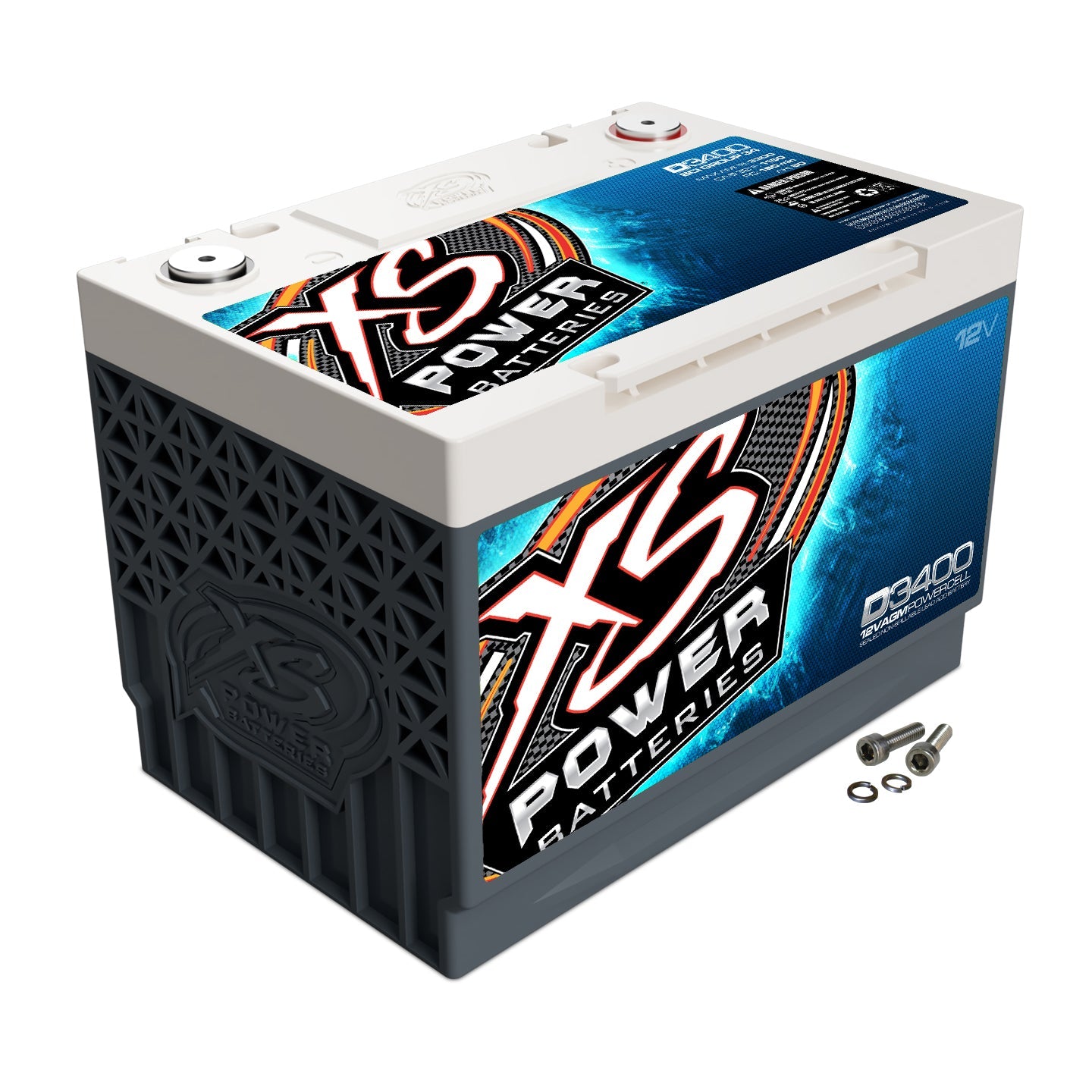
The D3400 is the benchmark. Group 34, 3,300 max amps, 1,012 cold cranking amps, 1,150 cranking amps, and 160 minutes of reserve capacity — enough to run your car while powering an audio system up to 2,500 watts, or 4,000 watts if you're using it as a secondary. It weighs 49.97 lbs and carries a 3-year warranty.
The rest of the AGM lineup splits by application:
S-Series
same core numbers as the D-Series in a racing package. The S3400 runs 3,300 max amps, 1,012 CCA, 80 Ah, 160-minute RC, with 580 terminal hardware included.
XP-Series
dedicated secondary/reserve. The XP3000 is a Group 31 at 3,000 watts, 120 Ah, and 240 minutes of reserve capacity. It's 73 lbs of pure energy bank for light bars, winches, inverters, and amps.
PS-Series
powersports.
V-Series
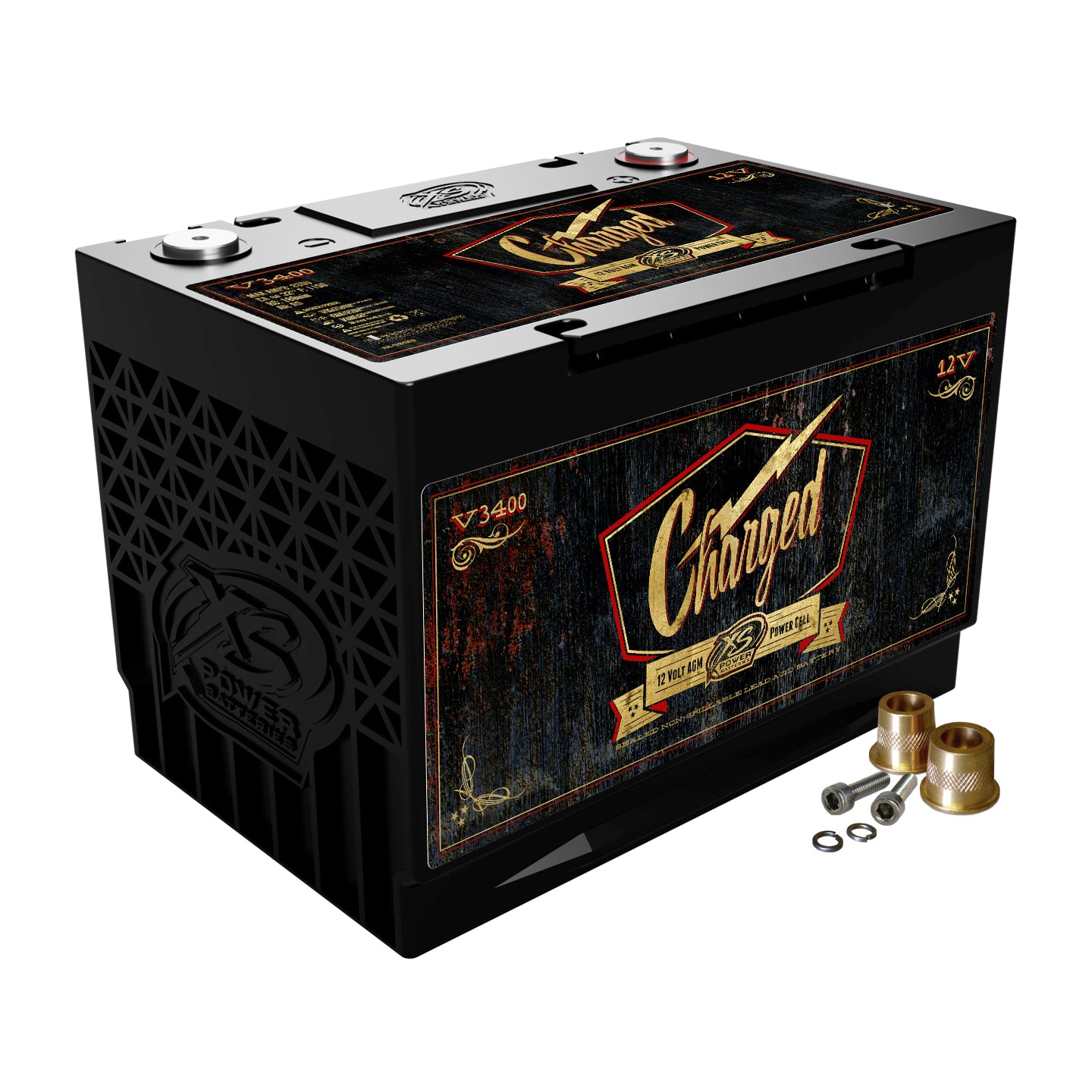
modern AGM guts in an antique-looking case for restorations.
6V, 14V, and 16V
for builds that don't run a standard 12-volt bus.
Where AGM wins: lowest cost per amp-hour, huge reserve capacity, tolerant of ordinary charging systems, and no drama about mounting location. If you're building a daily driver, a tow rig, or a moderate audio system on a stock or lightly upgraded alternator, this is the answer.
Where it doesn't: weight. Fifty pounds is fifty pounds, and if you're chasing a class weight break or a tenth in the quarter, that's the first place it hurts.
Lithium: Power-to-Weight
XS Power's lithium offerings are built mostly around two type of lithium: Lithium Iron Phosphate (LiFePo4) and lithium titanate oxide. Lithium Titanate Oxide (LTO) is a chemistry chosen for high-burst output and fast recharge rather than maximum energy density. Each have their place, but we'll start with breaking down LTO first.
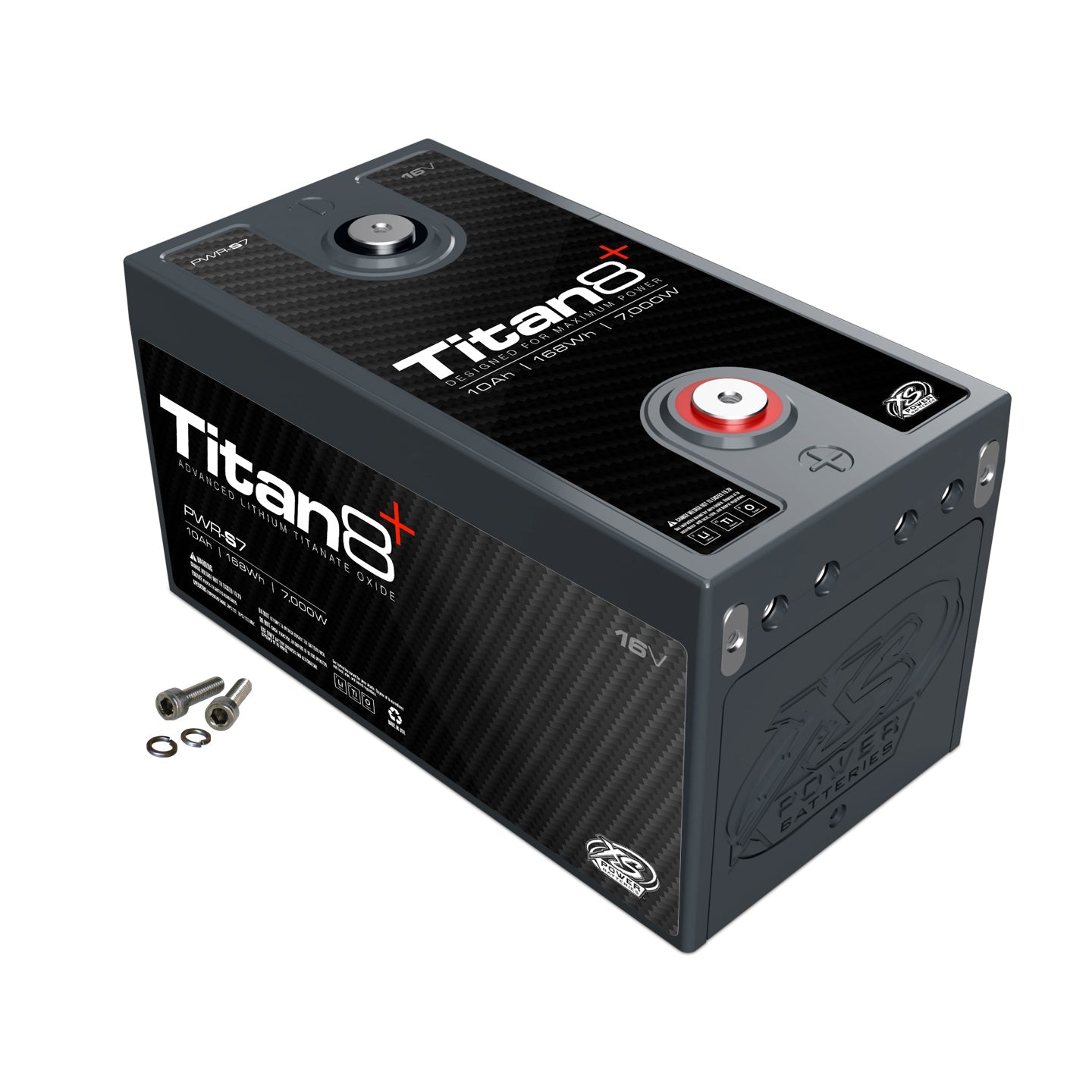
The Titan8 PWR-S5-4800 shows what that buys you. It's a Group 48/H6 direct-fit at 9.75 lbs — versus 49.97 lbs for the D4800 Group 48 AGM. It puts out 5,000 watts of burst power, 2,000 max amps, 1,000 cranking amps, and holds 240 watt-hours across 20 amp-hours. On top of that, XS Power offers a Four-year warranty on 12-volt Titan8 models. Being that every Titan8 model is comprised of Lithium Titanate Oxide, it's easy to see where the name came from.
Getting back into the specs, the 20 Ah number is the one people get wrong. XS Power publishes a "Pb Eq" figure alongside it — Pb equivalent — because lithium holds voltage under load far better than lead does. The PWR-S5-4800's 20 Ah behaves like 60 Ah of AGM, and its 1,000 CA behaves like 1,500 CA. Compare the equivalent numbers, not the raw ones.
Lithium iron phosphate is more energy dense in comparison to LTO, but each have their place in operation. With XS Power's xMAX-Series products, they are not rated for under-hood use or to be used around heat sources. They have a different resting voltage compared to AGM and Titan8, making mixing with other products more difficult. The benefit of xMAX is the raw power capabilities, with products like xMAX90 offering 20,000 watts of burst power. The energy per dollar is unmatched in comparison.
The rest of the lithium range:
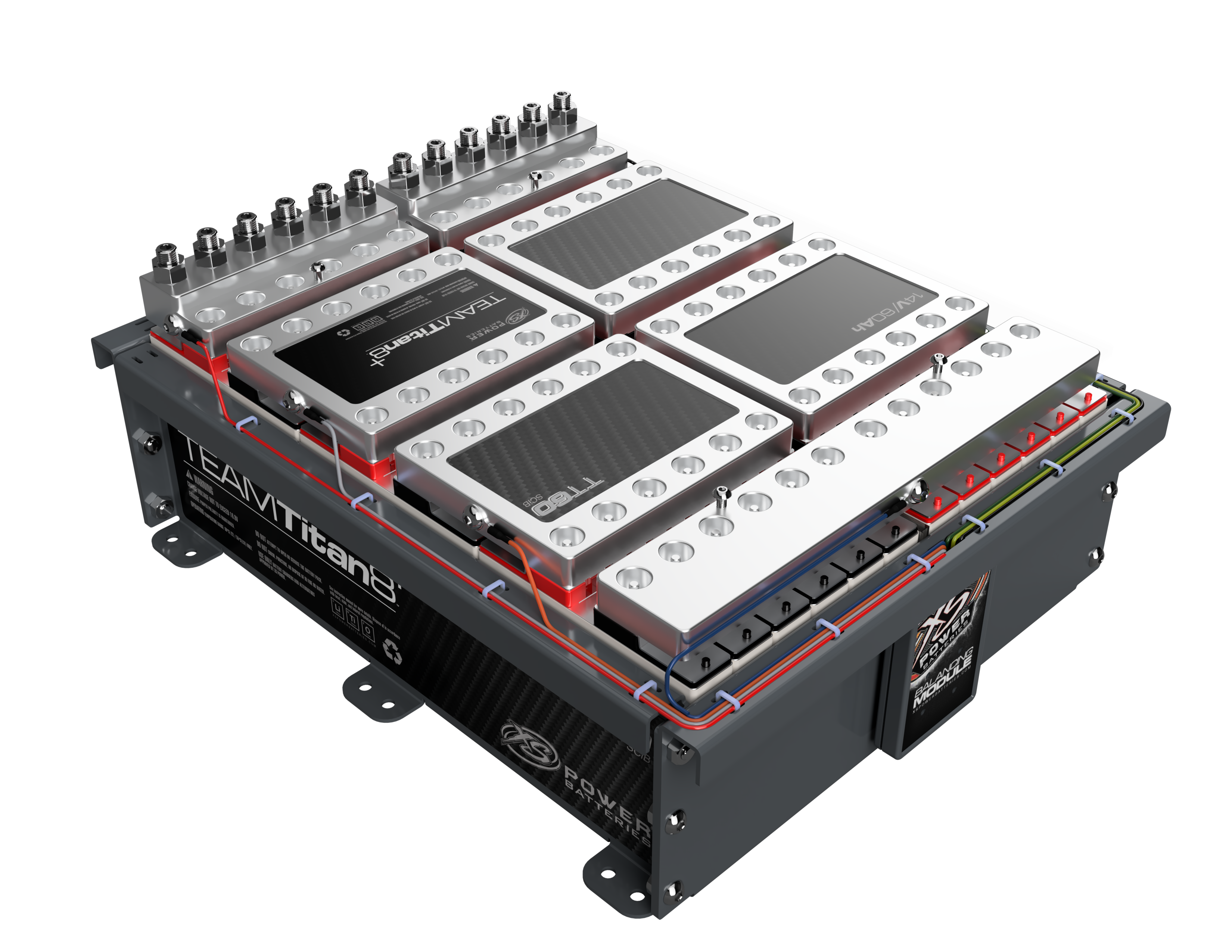
Titan8 modules (PWR and RSV)
build a custom bank in whatever space you have.
Titan8 Direct Fit
12V PWR-S5 and RSV, 14V PWR-S6, 16V PWR/RSV-S7.
XV-Series
powersports LTO. The XV14Q is 2.5 lbs, 335 CA, 670 max amps, 750 watts, with 3 Ah that acts like 10 Ah of AGM. Rated to last up to five times longer than a traditional AGM.
xMAX
the energy-density play. The xMAX 90-DIY is a prebuilt lithium PowerCell bank: 90 Ah (360 Ah Pb Eq), 1,188 watt-hours, 20,000 watts burst, 8,300 max amps, all in about 25 lbs with an active balancer included. In-cabin mounting only, and it requires a lithium-specific charger.
Where lithium wins: power-to-weight, fast recharge, and cycle life. A build that needs real reserve and needs to stay light has one honest option.
What to plan for: certain lithium types needs a lithium charger — the Li1208, Li1215, and Li1225 IntelliCHARGERS exist for exactly this. Don't put an AGM charger on it. And check the mounting restrictions on the xMAX series before you cut a bracket.
SuperBANKS: Not a Battery at All
This is where most of the confusion lives, so let's be blunt: a SuperBANK is not a battery. It's an ultracapacitor bank. It stores energy electrostatically rather than chemically, which changes everything about what it's good at.
Capacitors have almost no energy capacity. The US1100-31 UltraStart module — a Group 31 supercapacitor starting module rated at 700 CCA and 1,100 amps peak — holds 24 watt-hours. The Titan8 next to it holds 240. The SB75-5 holds 2.34 Wh.
What they do have is the ability to release and reabsorb that energy almost instantly, over and over, effectively forever. The SB1000 delivers a surge to the vehicle's battery as it cranks, then recharges in a matter of seconds, ready to go again. XS Power rates them to more than a million cycles, with a typical service life measured in decades, and they operate from -40°F to 150°F — which is why they shine in cold climates where an AGM cranks slowly.
The range scales by farads and watts:
| Model | Farads | Max Power | Weight |
|---|---|---|---|
| SB75-5 | 75 F | 600 W | 1.5 lbs |
| SB500-34 | 500 F | 4,000 W | 11 lbs |
| SB630-34 | 630 F | 5,000 W | 11 lbs |
| SB1000-31 | 1,000 F | 8,000 W | 22 lbs |
| SB1500-75 | 1,500 F | 12,000 W | 35 lbs |
There are 16V banks too — 430F, 860F, and 1050F — plus loose SuperCELLs like the 33-1200 (2.85V, 3,150 farads) for anyone building a custom bank from scratch.
Where SuperBANKS win: transient load. Bass note hits, headlights dim, voltage sags — that's a power delivery problem, not an energy storage problem, and a capacitor fixes power delivery problems. Same story on cranking: stabilized voltage means less stress on starters, relays, and engine control modules.
Where they don't: they can't run anything on their own for any meaningful length of time. SuperBANKS are designed to be connected in parallel with a lithium or AGM battery, not instead of one.
Side by Side
| AGM | Lithium (LTO) | SuperBANK | |
|---|---|---|---|
| Stores energy as | Chemical | Chemical | Electrostatic |
| Weight (Gr. 34-class) | ~50 lbs | ~10 lbs | ~11 lbs |
| Energy capacity | Highest per dollar | High | Very low |
| Burst current | Strong | Strongest | Instant |
| Recharge speed | Slowest | Fast | Seconds |
| Cycle life | Good | Up to 5× AGM | 1,000,000+ |
| Cold performance | Slower cranking | Good | Excellent (-40°F) |
| Charger | AGM IntelliCHARGER | Lithium or AGM IntelliCHARGER | AGM IntelliCHARGER |
| Warranty | 2–3 yr | 4 yr | 1–5 yr by model |
| Runs solo? | Yes | Yes | No — pair it |
So Which One?
Daily driver, tow rig, or a system under ~2,500 watts.
D-Series AGM. The D3400 does this job better than anything at the price, and it doesn't care what charger you own.
Race car or anything chasing weight.
Titan8 Direct Fit. Trading 50 lbs for 10 lbs while gaining burst output is the single easiest weight reduction on most builds.
Big audio — high wattage, long demos.
Lithium for the reserve, SuperBANK in parallel for the transients. The battery holds the energy; the capacitor delivers the punch. This is the combination competitors run, and it's why both product lines exist.
UTV, PWC, motorcycle.
PS-Series AGM if you want simple and cheap. XV-Series LTO if you want to drop 20 lbs off the machine.
Lights dim on bass hits, but the alternator's fine.
You don't need more battery. You need a SuperBANK.
Cold-climate slow cranking.
SuperBANK or the US1100-31 UltraStart in parallel with your existing battery.
Classic or restoration build.
V-Series. Modern performance, period-correct looks.
Not sure what fits?
Use the Find Your Battery tool on 4xspower.com for factory size fitment, or hit the Dealer Locator and talk to someone who's built what you're building.
XS Power Batteries has been powering the impossible since 2005. Shop AGM, Lithium, and SuperBANKS at 4xspower.com.